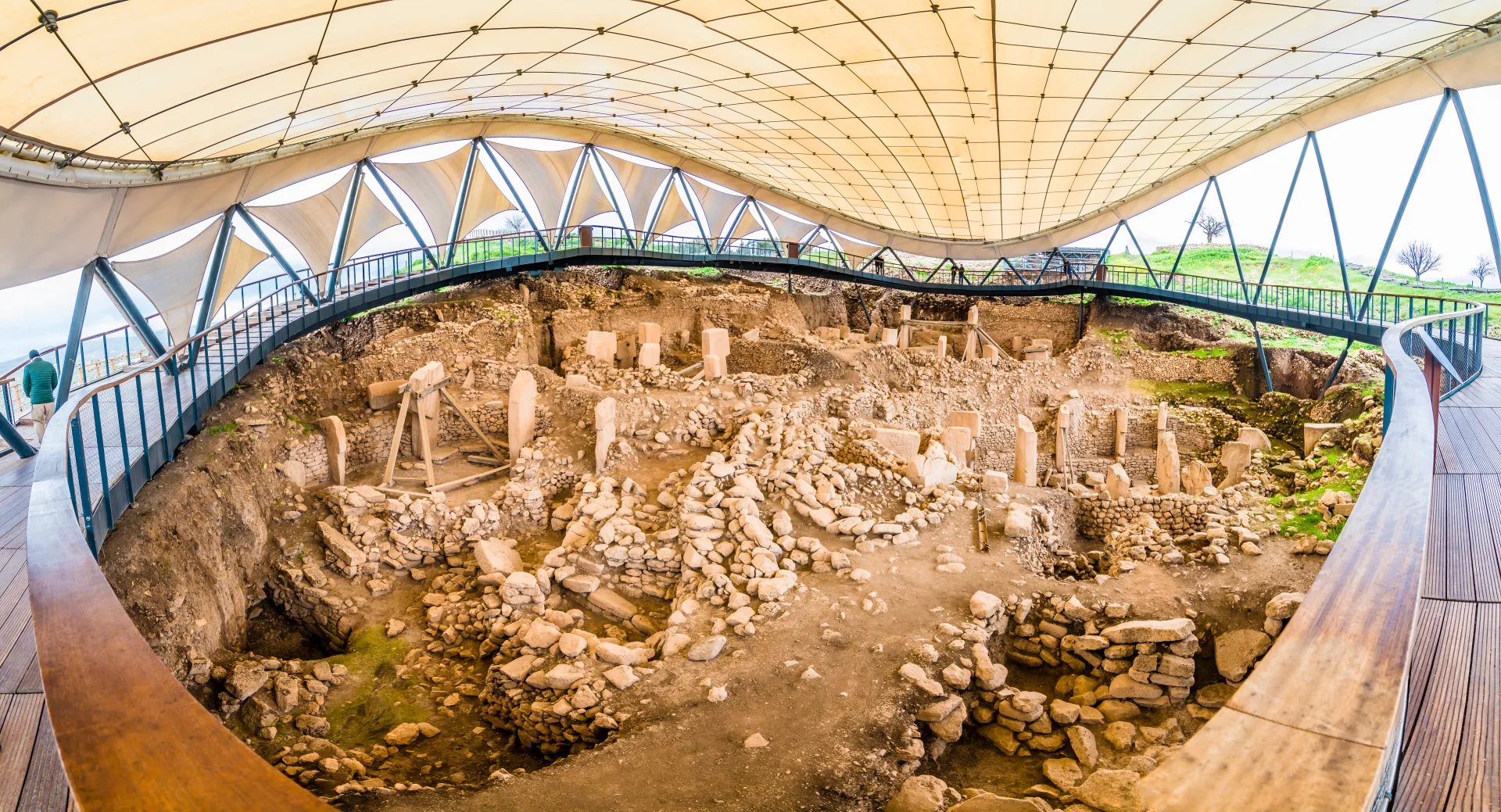
On a limestone ridge near Şanlıurfa, in southeastern Turkey, stand the oldest known monumental structures built by human beings. The great stone enclosures of Göbekli Tepe were raised more than eleven thousand years ago, thousands of years before pottery, writing or the wheel, and several millennia before Stonehenge or the pyramids of Egypt. Their discovery has transformed ideas about how and why people first came together to build. The site was inscribed on the UNESCO World Heritage List in 2018. This guide explains what you will see and how to plan a visit to the region.
Why Göbekli Tepe matters
The mound was recorded in a survey in the 1960s, but its importance was only recognised when the German archaeologist Klaus Schmidt, working with the German Archaeological Institute and the Şanlıurfa Museum, began excavating in 1995. Beneath the hill he found large circular and oval enclosures, ringed by stone pillars and dating to the tenth and ninth millennia BC, the Pre-Pottery Neolithic period. The builders lived at the very beginning of farming in the region, at a time when people still relied largely on hunting and gathering. How they organised such work, and what the enclosures were used for, remain subjects of lively debate: early interpretations stressed ritual gatherings, while more recent research has also found traces of everyday activity on the site.
What you see at the site
- T-shaped pillars. The central pillars of the main enclosures stand up to around five metres high. Some are clearly stylised human figures, with carved arms, hands and belts.
- Carved animals. Foxes, wild boar, snakes, vultures, scorpions, cranes and other creatures appear in relief on the stones, among the oldest known examples of monumental art.
- The enclosures. A large protective roof now shelters the main excavation area, and a walkway lets you look down into the enclosures from different angles.
- The visitor centre, with displays and a film introducing the site and its context.
Allow about one and a half to two hours, including the visitor centre. The site is about 15 km northeast of Şanlıurfa, roughly half an hour by road.
Beyond Göbekli Tepe: the Stone Hills
Göbekli Tepe is the best-known of a group of Neolithic sites in the hills around Şanlıurfa, now studied together as the Taş Tepeler, or "Stone Hills", project. At nearby Karahan Tepe, excavations have revealed carved heads and pillars of a similar age. Access to the newer sites varies with excavation work, so ask whether a visit is possible when you plan your dates.
Şanlıurfa and the region
Göbekli Tepe is best understood together with the Şanlıurfa Archaeology Museum, one of the largest in Turkey. It displays finds from the Neolithic sites, a full-size reconstruction of a Göbekli Tepe enclosure and the "Urfa Man", a stone statue some eleven thousand years old. Next door, the Haleplibahçe Mosaic Museum preserves Roman-era floor mosaics.
The city itself is one of the most atmospheric in Turkey. Around Balıklıgöl, the pools of sacred carp, local tradition places episodes of the life of the prophet Abraham, and the covered bazaars and caravanserais nearby are full of life. Some 45 km to the south, Harran is known for its beehive-shaped mud-brick houses and the ruins of an ancient city mentioned in the Bible. Further east, Mardin, with its honey-coloured stone houses overlooking the Mesopotamian plain, is roughly two and a half to three hours away, and the colossal statues of Mount Nemrut lie to the north.
Practical information
- Getting there. Şanlıurfa's GAP Airport has flights from Istanbul and Ankara. Most visitors fly in rather than drive from western Turkey, which is very far by road.
- How many days. Two days cover Şanlıurfa, Göbekli Tepe and Harran; three days let you add Mardin.
- Best season. Spring, from March to May, and autumn, from October to November, are ideal. Summers are extremely hot, often above 40°C, so visit early in the morning if you travel then.
- Local customs. Şanlıurfa is a conservative and devout city. Dress modestly, especially around the mosques and pilgrimage sites.
Frequently asked questions
Is Göbekli Tepe really a temple?
It was first described as a temple or sanctuary. Archaeologists now debate how far the enclosures were also used for daily life. Either way, they show that large communities cooperated on ambitious projects far earlier than once thought.
Can I visit Göbekli Tepe from Cappadocia?
It is far by road, so most travellers connect via a domestic flight, often through Istanbul or Ankara, and spend at least two nights in the region.
Southeast Turkey with Colorido
The private Southeast Turkey and Göbekli Tepe tour visits Şanlıurfa, Göbekli Tepe and Harran, with Mardin in its three-day version. Photographers can continue with Mardin photography and living heritage. For an overview of the region, see our Southeastern Anatolia destination guide and the guide to Turkey's history from the first settlements to the Republic.